Tunable Band Reject Filter for Multiple Bandwidth RF Testing
Digitally Tunable Band Reject Filter for Multiple Channel Bandwidths
Summary
As long as a band reject filter is wider than the bandwidth of the channel it should supress, it can fulfil its function. However, when we need to supress a channel and check for spurious emissions very close to it, the filter must be properly aligned. The idea is to align the filter edge with the channel edge.
Ranatec has developed digitally tunable band reject filters with very sharp slopes at the edges. They support alignment and suppression for all the allowed channel bandwidths of WiFi and 5G communication.
Introduction
Modern WiFi and mobile devices have adaptable bandwidths and operate in many frequency regions. This makes room for coexistence of many devices and efficient use of the radio spectrum.
Each combination of centre frequency and bandwidth provides an operating channel. There are hundreds of channels with bandwidths ranging from 5 to 160 MHz and frequencies ranging from 600 to 6425 MHz. There are initiatives of extending to 7125 or 8000 MHz.
In RF compliance testing, such as for spurious emissions and receiver blocking, it is necessary to suppress the operating channels during the tests. This must be done in turn for all channels supported by the device-under-test (DUT). Using a switchable filter bank with hundreds of fixed filters is too cumbersome, so the Ranatec RI 260 series of digitally tunable filters is the practical way forward.
Supporting Multiple Bandwidths with Only One Filter
It would be possible to have a set of digitally tunable band reject filters that suppress each allowed bandwidth. Then, the filter for the proper bandwidth is switched in and tuned to the operating channel frequencies. There would still be need for an instrument with about a dozen high performance filters.
However, Ranatec has gone one step further. Their RI 260 series has only one or two tunable cavity filters in each instrument. The trick is to use filters with wide bandwidths and sharp slopes. For example, the 160 MHz wide filter in the Ranatec RI 268 Tunable Bandreject Filter has slopes of 10 MHz. Therefore it can support all bandwidths from 10 to 160 MHz.
The reason for this is that the measurements need to be made as close to the operating channel as one channel bandwidth away. For a 40 MHz channel, as an example, spurious emissions should be verified up to a frequency separation of 40 MHz outside the lower and upper edge of the operating band.
Tuning the Bandreject Filter Correctly
Most often, the digitally tunable band reject filter will have a larger bandwidth than the operating channel occupies. Then it cannot be tuned to the channel centre frequency, because it would overshoot both downwards and upwards and thereby also reject the spurious emissions that are to be detected. Instead, it is proper to align the band reject edge with the channel edge. This is done in turn for the upper and lower frequency edge of the operating channel.
As an example, consider the Ranatec RI 266 Digitally Tuable Band Reject Filter, which contains two high-Q metal cavity bandreject filters with 100 and 5 MHz fixed bandwidths. These are frequency transformed to the needed channel frequency bands. In order to support also other 5G bandwidths, the filters have steep slopes, 10 and 3 MHz, respectively.
Even if the filters in the RI 266 have fixed 5 & 100 MHz bandwidths, they can be used to measure for all relevant 5G mobile communication channel bandwidths.
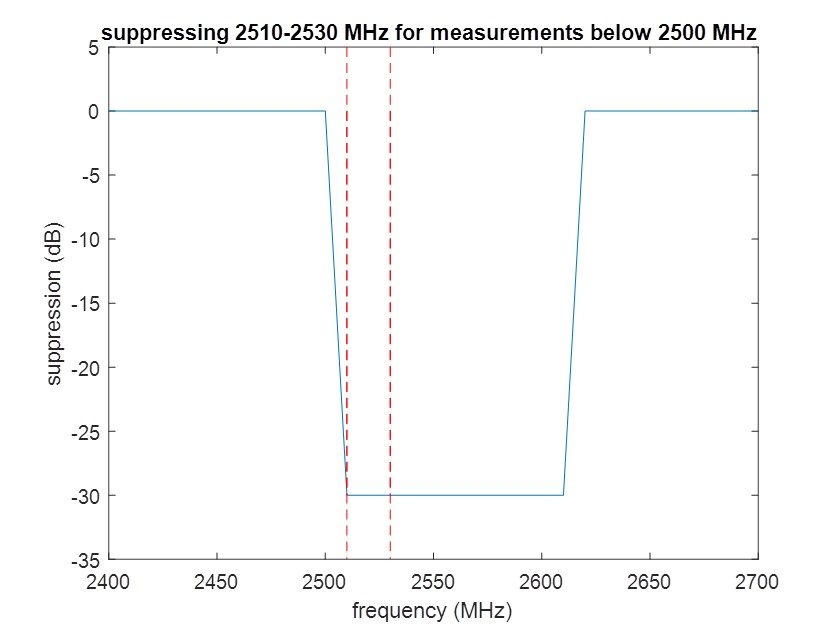 Consider now the picture to the right. The dashed lines show a 20 MHz channel at 2510-2530 MHz. The solid line shows the filter setting. The tunable band reject filter has here been offset to have its lower edge at 2510 MHz. The filter slope is just 10 MHz, which is very steep. This means that at 2500 MHz and below, there is no rejection.
This is how we propose to handle 20 MHz channels and of course vice versa with the setting for measuring at frequencies above the channel. For all other channel bandwidths the procedure is the same, just with the proper offsets.
Using an Automated Test System
The Digitally Tunable Band Reject Filter is intended to be part of an RF test system. Ranatec also provides the following instruments for the system, providing simple automation and signal conditioning:
- Switch Boxes
- Step Attenuators
- Tunable Filters
- Butler Matrices
- Shield Box Enclosures
- Feedthrough Filter
Visit us at ranatec.com and follow our latest news on LinkedIn and Twitter.
If you would like more information about this topic, please e-mail us on info@ranatec.com or call us on +46317061660