How to Build a Test System for 5G, WiFi and Bluetooth

Building an RF Test System for Wireless Devices
A state-of-the-art test system for communication devices is a setup with
• measurement instruments
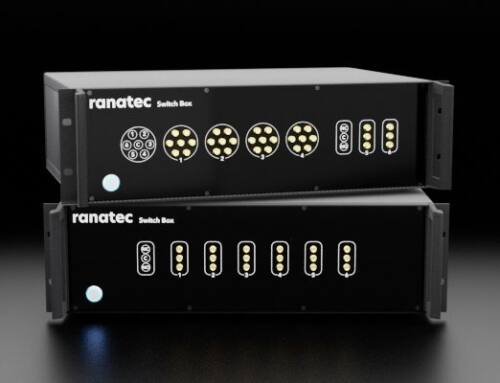
• switch boxes
• attenuators
• tunable filters
• Butler Matrices
• shield box enclosures
• control computer
that runs through calibration and thousands of tests to ensure compliance to the requirements for 5G, WiFi or Bluetooth/BLE.
Introduction
The radio frequency (RF) requirements on modern communication devices are comprehensive and demanding. To ensure that 5G, WiFi and Bluetooth/BLE devices can coexist in large numbers, they must both sustain radio interference from the surroundings and restrict their own unwanted emissions.
Both during the design of such devices and for certification, automated systems are needed to step through all the tests that are called for. It actually adds up to thousands of actual measurements for each device.
A test setup is built up by connecting instruments, components and devices in a switched network. A computer controls the switches and other equipment first in a guided calibration and then in a systematic test sequence. All measurement data is saved along with a measurement log and a post processing software is used to analyze the results for compliance and generate graphs and reports.
Switching and Routing for Test Equipment and Device-Under-Test
At the centre of an RF test setup for communication devices is a switch box. It consists of a number of multi-pole switches and interconnects the proper pathways for signals between different parts of the setup. The RF signals are relayed from source to receiver via conditioning blocks in between.
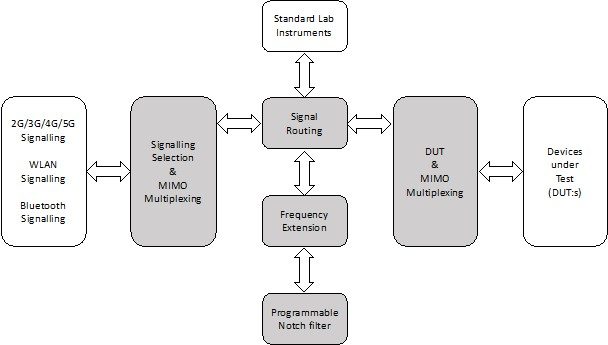
A block schematic of a typical RF test setup is shown below. Instruments dedicated for RF communication testing are at the left and standard lab instruments, such as power meters and spectrum analyzers are at the top. To the left are the devices-under-test (DUTs) and at the bottom are dedicated filter units.
Additional signal conditioning units are located between the other blocks and a switch box at the setup core manages the signal routing. All parts of the setup are controlled by a computer which also handles the calibration and data storage.
There are many details in the test setup that need careful consideration. For example, all RF components have their particular operating frequency range. It is wise to use parts that support both the current technology state-of-the-art and extensions expected in the near future. We also recommend to include some spare connectors at switches and filter boxes to facilitate later additions to the setup.
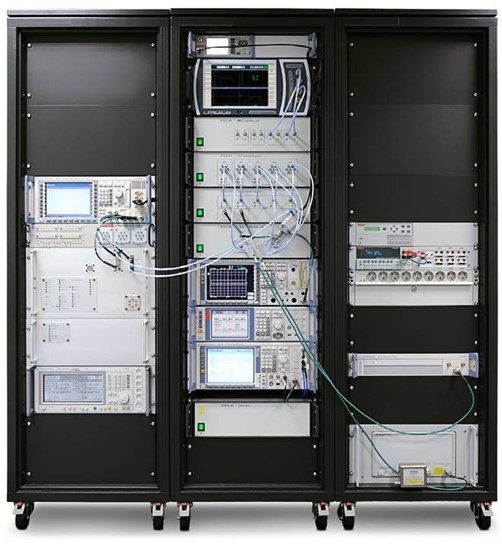
The photo to the right shows an actual test setup for communication devices. The parts are placed in standard 19-inch racks. Some of the cable routing is seen at the front side, but most of it is located at the back side.
The Communication Device to be Tested
Some consideration should be taken concerning the device to be tested. If the regulatory standard allows for it, it is always best to attach the antenna with a connector. Then, most of the requirements can be tested at the connector port. This is much more straight-forward than testing over-the-air (OTA).
In particular, some requirements should be fulfilled over the operating temperature range of the device. As the device is placed in a temperature chamber, it will experience a very odd propagation environment if it is tested OTA. The tests would not reflect the actual performance of the device.
It is also very useful to add test conectors at various positions along the RF chain in the device design. Should there be some deviation from the requirements in the device tests, the test connectors can be used to located the source and root cause of the fault.
For some devices and measurements, OTA testing might be needed. The standards usually allow for a choice between anechoic chamber, semi-anechoic chamber or reverberation chamber. A number of designs are available for off-the-shelf purchase from many vendors.
In any case, it is important to place the DUT in a shield box to isolate it from all RF signals that fill the air in the lab environment. The routing of signals into the test boxes is achieved using feedthrough filters.
Standard Communication Test Instruments
The following standard RF measurement instruments are normally part of a communication test setup.
• Radio Communication Tester
• Signal Generator/Synthesizer
• Spectrum Analyzer/Measurement Receiver
• Power Meter
• Adjustable Power Supply
Additional Components for Signal Conditioning
In addition to the standard RF measurement instruments, Ranatec provides several units that are needed for signal conditioning. It is about adjusting signal power levels, filtering out signals that interfer with the measurements and providing MIMO signal mixing.
Digital attenuator boxes are used to set signal power levels to the proper values for each test. For example, sensitivity requirements state that a receiver should function even at low input signal powers.
Tunable bandreject filters are used in spurious emission and receiver blocking tests. They suppress the channel inband signal to make sure it does not saturate the measurements.
Butler matrices mix all of their input signals into all of their outputs. Therefor they are used in MIMO testing to emualate a multipath propagation environment. Connectorized testing of MIMO is superior to OTA testing, because amplitudes and phases of all input and output signals can be controlled and varied over the tests.
Ranatec Wants to be Part of Your Test System Development
With decades of experience, Ranatec provides signal conditioning units for test systems. There are standard units provided to many test labs and specialized units developed in close cooperation with a particular lab. Feel free to get in touch, we would be happy to help you out!
Visit us at ranatec.com and follow our latest news on LinkedIn and Twitter.
If you would like more information about this topic, please e-mail us on info@ranatec.com or call us on +46317061660